News
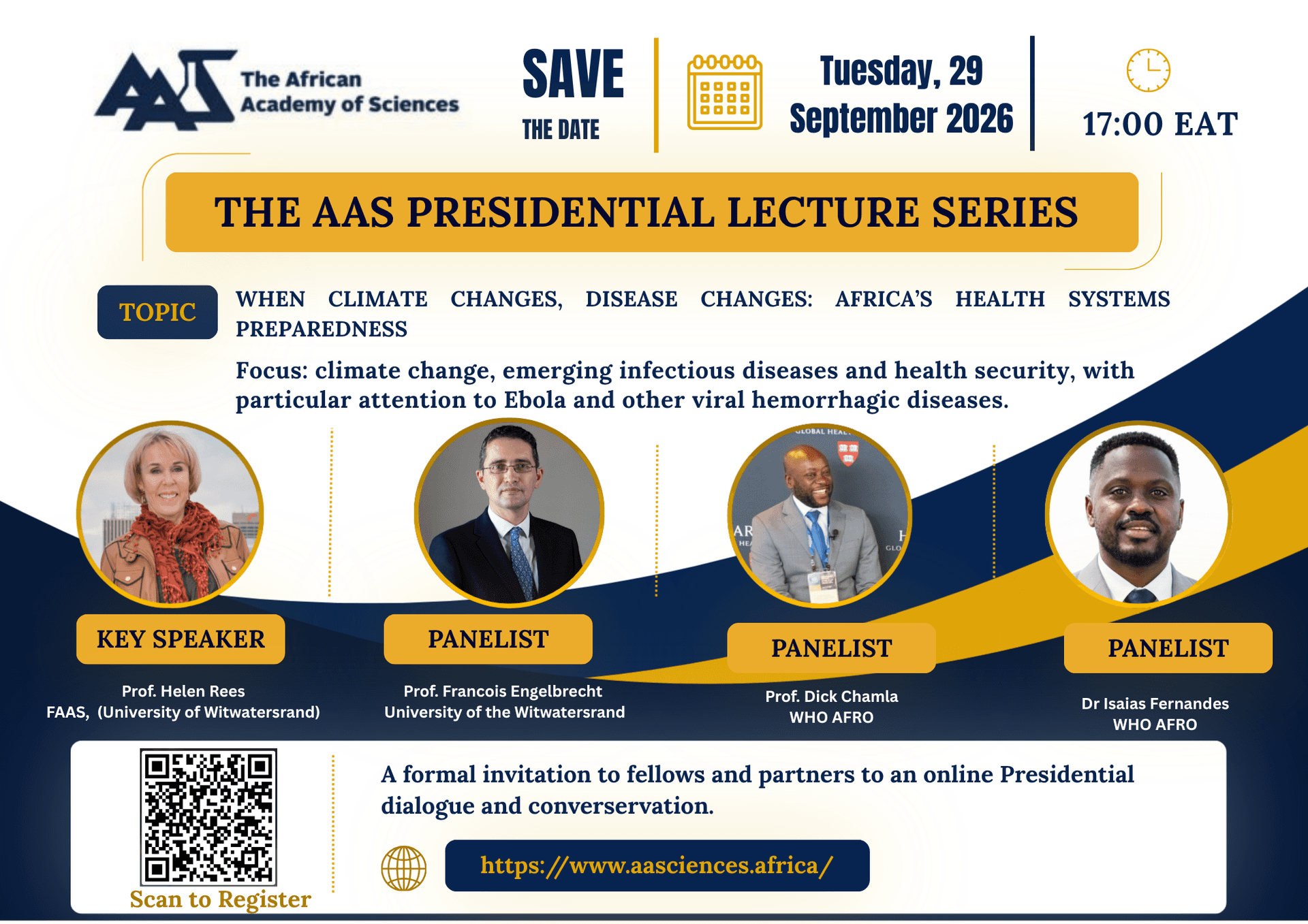
African countries must strengthen the use of climate science in public health planning to anticipate disease outbreaks, protect vulnerable communities and prepare for increasingly severe weather. This was the central message of the African Academy of Sciences (AAS) Presidential Lecture held online on 29 September 2026.
Convened under the theme “ When climate changes, disease changes: Africa’s health systems preparedness ” the lecture brought together experts in climate science, infectious diseases and health emergency preparedness. The discussion examined how rising temperatures and changing rainfall patterns are affecting Africa’s health risks, and how scientific evidence can support earlier and more effective responses.
The programme featured AAS President Prof. Friday Okonofua, Prof. Francois Engelbrecht, Prof. Helen Rees, Dr. Dick Chamla and Dr. Isaias Fernandes, with Prof. Marleen Temmerman guiding the discussion and concluding reflections.
Prof. Engelbrecht presented projections indicating that the developing El Niño could become exceptionally strong, bringing heightened risks of drought and extreme heat to Southern Africa and parts of West Africa, alongside above-normal rainfall and potential flooding in East Africa.
He explained that global warming is intensifying the risks associated with climate variability, with consequences for agriculture, water availability, human health and wildlife. His presentation underscored the importance of incorporating climate forecasts into government, business and community planning so that preparations begin before extreme conditions develop.
Prof. Rees explored how climate hazards influence infectious diseases by changing the geographical range of disease-carrying vectors, increasing contact between people and pathogens, and weakening the conditions that protect health.
Her presentation highlighted threats associated with the spread of mosquitoes, including Anopheles stephensi, alongside risks from dengue and cholera. She also drew attention to rapid urbanisation and inadequate housing, water and sanitation in informal settlements, where climate pressures can deepen existing vulnerabilities.
Against a backdrop of constrained global health financing, Prof. Rees emphasised practical measures to reduce risks. This included protecting biodiversity, eliminating mosquito breeding sites, improving access to safe water and sanitation, and addressing misinformation about climate change and vaccines.
Dr. Chamla, from the World Health Organization (WHO) Regional Office for Africa, examined the continent’s preparedness for overlapping public health emergencies. He highlighted persistent gaps in countries’ ability to prevent, detect and respond to threats, including infectious disease outbreaks and heatwaves.
His presentation stressed the need to translate risk assessments into operational readiness: identifying priority hazards, positioning critical supplies, strengthening coordination and conducting exercises to test whether response systems can function effectively under pressure.
The session also featured a demonstration of the Preparedness Data Exchange (PDX), an AI-enabled platform designed to bring together information on hazards, health threats and preparedness. The demonstration illustrated how integrated data and predictive analysis can help countries identify emerging risks and guide action before emergencies escalate.
In her concluding reflections, Prof. Temmerman highlighted the Academy’s potential to connect scientific expertise with policy and public understanding. She recommended stronger investment in knowledge translation, closer collaboration with organisations such as WHO and the wider United Nations system, and greater engagement with the media.
The lecture reinforced the importance of the AAS as a forum for bringing different disciplines together around Africa’s development challenges. Across the presentations, the priority was clear: climate evidence must inform health planning, investment and public communication early enough to protect lives and livelihoods.
To watch the webinar, visit the AAS YouTube channel linked here.