News
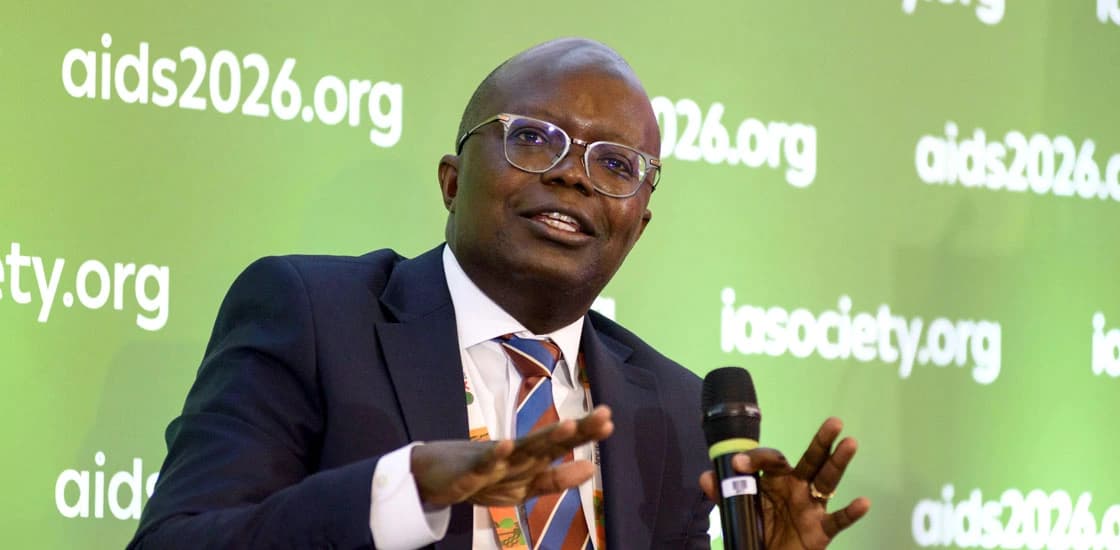
The International AIDS Society (IAS), which pushes for science-based HIV/AIDS policies, is now led by Kenneth Ngure, an HIV/AIDS research scientist and an associate professor at the School of Public Health, Jomo Kenyatta University of Agriculture and Technology (JKUAT), Kenya.
Ngure is also an affiliate professor at the department of global health, University of Washington, a fellow of the African Academy of Sciences and a member of the World Health Organization’s Technical Advisory Group on sexually transmitted infections.
His ascension to the helm of the IAS during the 26th International AIDS Conference held in Rio, Brazil, recognises his contributions to HIV prevention research and global health, and his efforts to advance evidence-based approaches to the HIV epidemic. His work has helped strengthen Africa’s role in shaping the global HIV research and policy agenda.
His interest in HIV and AIDS was sparked in high school after watching a television news item on an unproven drug being promoted at the time as a cure for HIV – a compound with antiviral activity, but not a genuine cure.
Aired at a time when AIDS was causing devastating deaths in his community, the report clarified for him what he wanted to do after school. That path led to a PhD in public health from JKUAT.
University World News (UWN) spoke to him about his work and vision.
UWN: You are one of the few Africans to become president of the IAS. What does your election signify about the role of African universities in leading global health research?
KN: I would say it shows African universities can shape the global health research agenda and not simply participate in it.
Most of my work is on HIV prevention. These HIV prevention studies have been conducted in Africa among African communities and have been led by African researchers in collaboration with other researchers.
As you know, Africa is the bedrock of the HIV pandemic.
UWN: What is your agenda as president of the IAS as you take over at a time of funding cuts and new prevention technologies?
KN: My priority will be to help turn scientific progress into equitable access. We have promising prevention choices, including twice-yearly lenacapavir, at the same time that funding pressures threaten essential services.
The IAS can bring researchers, communities, governments and funders together to protect the HIV response and make sure new tools reach the people who need them most. I also want to strengthen the next generation of scientists, particularly in regions most affected by HIV.
[We] will be not measured by the discoveries that we make, but in terms of the change we bring to the HIV pandemic.
UWN: You have been at JKUAT for more than 15 years, starting from lecturer and moving up to become dean. What has enabled JKUAT to produce globally competitive researchers?
KN: I’ve been at JKUAT for over 15 years but I have been conducting global health research for close to 30 years. JKUAT has given faculty members room to conduct research, build long-term programmes, teach, mentor and form partnerships.
For me, the opportunity to work closely with colleagues and communities in Kenya has been especially valuable.
My faculty colleagues and I have received a lot of support from the JKUAT administration, led by Vice-Chancellor Professor Victoria Ngumi, to pursue research and our research interests.
My university considers research as part of its vision and mission, which demonstrates that global competitiveness grows when targeted people get institutional support, rigorous training and have the freedom to pursue questions that matter locally.
UWN: What do your World Health Organization (WHO) and IAS roles bring back to JKUAT in terms of students, grants, labs, collaborations?
KN: What happens with these kinds of international roles, both at the WHO and the IAS, is that they connect the university to the international community and, when connected, they open many doors for students and even for other faculty members.
For example, if students know that a specific faculty member is in a certain institution, they show a keen interest, and they are able to look into that institution, and by becoming members in some institutions, like the IAS, they are also able to access the resources that are available for members.
As we get grants depending on the type of study we do, capacities and infrastructure are also developed to match the needs we have for the specific study.
This is not only for me and in my current roles, but for many of the faculty members who also have international collaborations with different organisations which are benefiting their local institutions.
I mentioned earlier that I am also an affiliate professor at the department of global health of the University of Washington. This puts me in a position to collaborate with the University of Washington faculty in grant-writing, teaching and co-supervision of postgraduate students.
Currently, through a collaborative grant, two of our faculty members from the school of public health are at the University of Washington where they are receiving training. And then, once they come back, they are expected to look into strengthening our teaching curriculum, especially on the implementation of science and social behavioural methods.
UWN: Many African academics leave the continent. Why have you stayed at a Kenyan public university, and what needs to change to retain top talent?
KN: I have stayed at a Kenyan university because I know that my research questions are best answered from the African continent.
JKUAT has allowed me to combine research, teaching and public service – and even global service – while helping students and junior faculty to build their careers.
So, to retain talent, universities need to provide a conducive environment for their faculty members to have protected time for research, to have administrative support from the highest level, which will enable them to build competitive career paths.
I travel a lot to more developed countries and universities but I still come back to bring the learning and resources back home.
UWN: You were part of the landmark Partners Pre-exposure Prophylaxis Study (PrEP Study). How has research training in African universities evolved since then?
KN: I had participated in other important studies before the Partners PrEP study; but the Partners PrEP study that was done in Kenya and Uganda is one of the landmark studies that I participated in as one of the investigators.
This study demonstrated that oral Pre-Exposure Prophylaxis, or PrEP, was safe and efficacious and contributed to the policy we have today, namely of having oral PrEP as one of the prevention tools available in many African countries. The results were published in the prestigious New England Journal of Medicine and, so far, that article has been quoted 4,000 times.
And, while conducting that study, many junior researchers who did not have experience in conducting clinical trials got training and experience and some of them are leading their own trials as principal investigators.
Most of these studies are conducted in collaboration with investigators from more established institutions. This leads to capacity transfer whereby local researchers get trained to conduct these kinds of studies in a rigorous fashion and eventually they transition to become independent researchers.
Physical infrastructure is also developed during these collaborative studies – some of our Kenyan institutions have world-class laboratories courtesy of conducting these kinds of studies.
UWN: What are the biggest barriers for African universities to lead multicountry trials, not just be implementation sites?
KN: The biggest barriers are structural: access to major funding, the cost of maintaining trial infrastructure between grants, and limited support for contracts, data systems and regulatory coordination.
Experienced investigators are here. What they need are institutions that can serve as coordinating centres, with the authority and resources to set the scientific agenda, manage partners and develop the next generation of trial leaders.
UWN: For a young researcher wanting to follow your path, what practical steps should they take?
KN: Start with a problem you care deeply about and learn the methods needed to study it well. For example, one of my masters degrees is in clinical trials from the University of London, United Kingdom, which I pursued because I wanted to get the training needed to conduct clinical trials effectively.
Secondly, young researchers should find mentors who will challenge them. I have been fortunate to have some of the best local and international mentors.
Additionally, as a junior researcher, you should collaborate generously, write regularly and take responsibility for your assigned part of every project. Build strong relationships with communities and health programmes; they will sharpen your questions. And, as you progress, create opportunities for others. A research career is built through sustained work and trust.
UWN: As African universities face funding cuts and donor dependency, what is your message to vice-chancellors on sustaining health research?
KN: As you have seen in the recent past, donor funding, although great, may not be sustainable and sometimes it may come with strings attached – and sometimes the questions that local investigators want to address may not fit with the priorities of international donors.
So, I would advocate for the vice-chancellors to look for creative ways to ensure that universities have domestic funding that can be available to faculty so that, even as faculty seek other sources of funding, those additional sources become supplemental. And this will also ensure sustainability of the research agenda.
And, then, the next thing is also to provide and protect the time for faculty members who are engaging in research so that they can be enabled to conduct research of the highest standard.
When a university builds a strong research portfolio available to faculty members, the faculty will also, in return, support the university to build its brand, support the students and other faculty members, bring in additional funding, and eventually this is going to benefit or impact the local community.
Original article written by Clemence Manyukwe and published in University World News.